
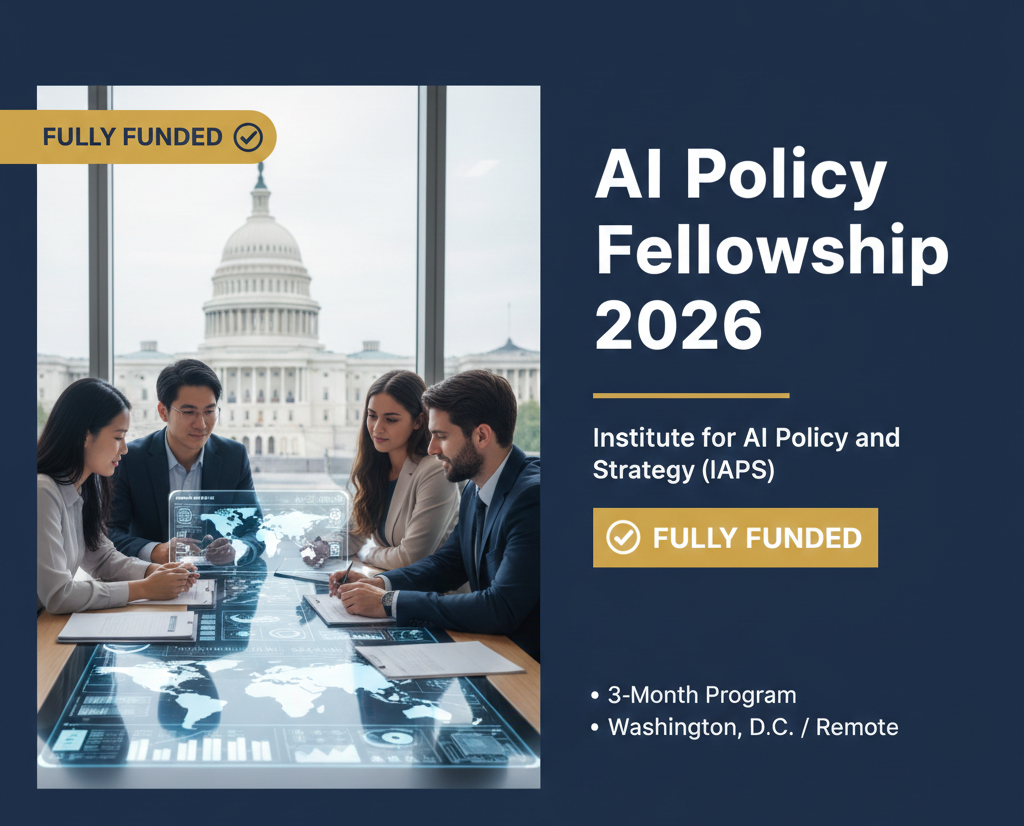
If you are passionate about artificial intelligence, public policy, national security, or global governance, the AI Policy Fellowship 2026 by the Institute for AI Policy and Strategy (IAPS) is one of the most prestigious opportunities you can apply to this year.
This 3-month, full-time fellowship offers hands-on experience in shaping real-world AI policy, mentorship from world-class experts, and a high-value stipend—with the flexibility to work from Washington, D.C. or remotely.
Fellowship at a Glance
- Organizer: Institute for AI Policy and Strategy (IAPS)
- Duration: June 1 – August 21, 2026 (3 Months)
- Format: Hybrid (In-person in D.C. or Remote)
- Mandatory Residency: June 1–12, 2026 (All fellows meet in Washington, D.C.)
- Link: Apply to the IAPS AI Policy Summer Fellowship 2026
- Application Deadline: February 2, 2026 (23:59 PT)
- Stipend: Fellows: $15,000 USD
- Senior Fellows: $22,000 USD
What Is the AI Policy Fellowship?
The IAPS fellowship is designed to build the next generation of leaders who will ensure a safe and globally beneficial AI future. Unlike theoretical programs, this is applied policy work. Fellows conduct independent projects that directly influence national and international decision-making.
Location & Structure
Whether you choose the in-person or remote track, the program begins with an intensive two-week residency in Washington, D.C. (June 1–12).
- In-Person (D.C.): You will have dedicated office space and attend regular briefings, roundtables, and high-level networking events.
- Remote Option: Open to applicants worldwide. IAPS provides a dedicated support budget for fellows to attend conferences and travel for in-person meetings.
Key Focus Areas & Projects
You don’t just “study” AI; you contribute to solving its most pressing challenges. Fellows work on:
- AI & National Security: Analyzing CBRN risks and frontier model safety.
- Geopolitics: Export controls, hardware mechanisms, and US-China competition.
- Governance: Government procurement, AI Safety Institutes, and jurisdiction-specific policies (US, UK, EU).
Concrete Outputs: Fellows often author policy memos for government officials, publish op-eds in major outlets, or organize international policy conferences.
Who Should Apply?
IAPS welcomes a diverse range of seniority levels—from undergraduate students to senior professionals with decades of experience.
- No Technical Degree Required: You do not need to be an AI engineer. Applicants from law, government, industry, and social sciences are highly encouraged to apply.
- Global Eligibility: Open to all nationalities. IAPS is a remote-first organization capable of hiring and paying fellows in many countries.
❓ Frequently Asked Questions (FAQ)
Do I need prior policy experience?
Not necessarily. While helpful, IAPS looks for candidates with strong judgment and an aptitude for understanding AI’s implications.
Will they fund the travel for international participants?
Yes. For the mandatory two-week residency (June 1–12) in Washington, D.C., the program is fully funded. This typically includes:
- A “support budget” for remote fellows to attend other conferences or meetings
- Round-trip airfare to D.C.
- Accommodation and meals during the residency.
Is the fellowship only for D.C. residents?
No! People from across the globe are encouraged to apply. You can choose to be fully in-person in D.C. or participate remotely from your home country.
I have a technical degree (CS/Engineering). Is this for me?”
Absolutely. While a technical degree is not required, it is a massive asset. IAPS specifically welcomes technologists and AI researchers who want to transition into policy. Your ability to understand frontier model architecture, compute governance, or AI safety evaluations is exactly what policymakers need to make informed decisions.
Does IAPS sponsor work visas?
No. IAPS does not sponsor visas for the fellowship.
- In-Person Fellows: You must already have the legal right to work in the U.S. (e.g., U.S. citizenship, Green Card, or F-1 OPT/CPT).
- Remote Fellows: You must already have (or be able to obtain) a standard visitor visa (like a B1/B2) to attend the 2-week D.C. kickoff.I have a technical degree (CS/Engineering). Is this for me?” Absolutely. While a technical degree is not required, it is a massive asset. IAPS specifically welcomes technologists and AI researchers who want to transition into policy. Your ability to understand frontier model architecture, compute governance, or AI safety evaluations is exactly what policymakers need to make informed decisions.
💡 Potenue Insider Tip
If you are applying from abroad, don’t let the visa requirement scare you off. Getting a standard visitor visa (B1/B2) for a two-week “business residency” or “professional conference” is much easier than getting a long-term work visa. In your application, focus on your global perspective—IAPS specifically looks for experts who understand AI policy in jurisdictions like the EU, UK, or emerging markets.