
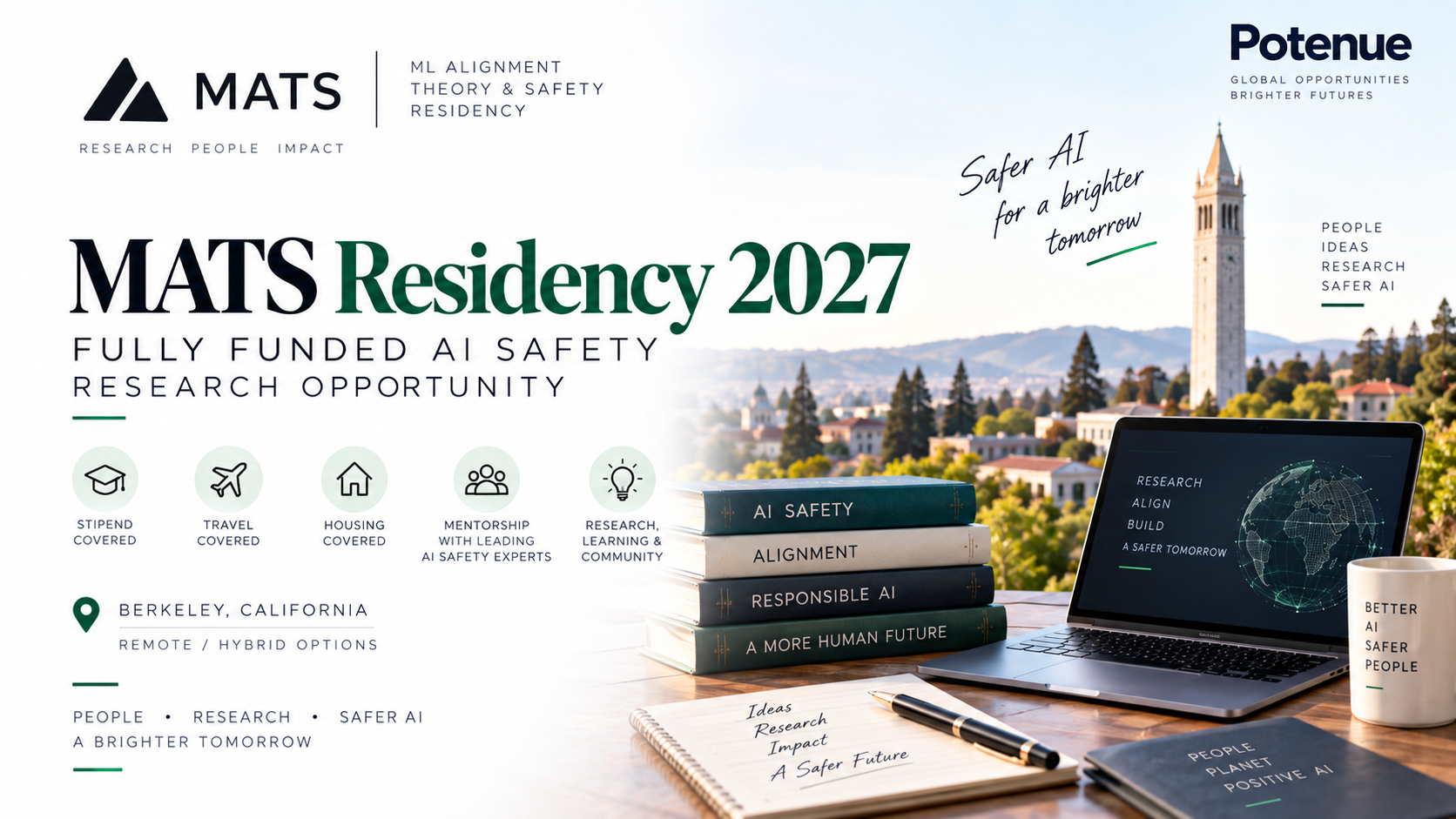
What if you could build a research career in AI safety with funding, compute, mentorship and access to leading researchers — without needing a traditional PhD or previous AI safety job?
The MATS (Machine Alignment Transparency and Security) Residency is an international research program for talented researchers, engineers and professionals working on ambitious problems related to AI alignment, AI safety, security and governance.
The programme supports researchers pursuing their own research agenda while providing access to experienced advisors, research infrastructure and a global AI safety community.
Quick Facts
- Opportunity Type: AI Safety Research Residency
- Host: MATS
- Duration: 6–24 months, depending on track
- Commitment: Full-time
- Locations: London, Berkeley and Washington, DC
- Format: Hybrid
- Funding: Paid
- Annual Compensation: $155,000–$285,000 USD gross
- Relocation Support: Up to $25,000
- Visa Support: Available where required
- Application Fee: No application fee
- Nationality: International applicants accepted
- PhD Required: No
- Application Deadline: October 31, 2026 (AoE) for Winter 2027
- Expected Start: Early 2027
What Is the MATS Residency?
MATS is designed for researchers who want to pursue long-horizon AI safety research that may not fit neatly into conventional academic or industry roles.
Rather than assigning every participant the same project, the Residency allows researchers to develop and pursue their own research agenda with structured support and periodic reviews.
Current areas of interest include:
- AI-assisted alignment research
- AI safety evaluations
- Safety cases
- AI assurance
- Technical AI governance
- Agentic and multi-agent AI safety
- Alignment research and foundational questions
MATS states that it assesses applicants primarily on the quality and seriousness of their work, rather than simply looking at job titles or academic credentials.
Choose Your Research Track
The current Residency has three tracks designed around different career paths.
Bridge
Designed for experienced academics, researchers and industry professionals transitioning into AI safety from adjacent fields.
Relevant backgrounds can include:
- Mathematics
- Physics
- Neuroscience
- Law
- Other technical or research disciplines
Bridge participants receive support with research and potential placement into longer-term AI safety roles.
Anchor
Designed for researchers who want to make AI safety research their long-term research career.
The focus is on developing an independent research agenda with continued institutional support.
Incubation
Designed for researchers and founders developing a new research paradigm, organisation or initiative in AI safety.
The track can provide support around research development, fundraising, governance and potential launch.
What Does the MATS Residency Pay?
This is a paid research residency.
According to the current MATS Residency information, Residents receive:
Annual Compensation
$155,000–$285,000 USD gross per year.
The exact amount depends on factors including experience, seniority, circumstances and the cost of living associated with the office location.
Research Compute
Residents receive research compute with no preset cap, with resources provisioned according to research needs.
Relocation Support
MATS provides up to $25,000 in relocation support, including eligible relocation costs for a partner and dependent children.
Other Benefits
Depending on location and employment arrangement, benefits include:
- Medical, dental, vision and life insurance
- Retirement benefits
- Paid leave
- Conference and research-event funding
- Catered meals on in-office workdays
Where Is the Residency Based?
MATS currently operates from three locations:
- London, United Kingdom
- Berkeley, California, USA
- Washington, D.C., USA
The Residency is hybrid. Residents are expected to spend at least one-third of their Residency working in person from MATS offices, although they can move between the offices depending on their research needs.
International applicants can apply, and MATS provides visa support where required.
Who Can Apply?
One of the interesting aspects of MATS is that a PhD is not required.
MATS states that applicants do not need:
- A PhD
- A formal “researcher” job title
- An extensive publication record
- Previous AI safety experience
Instead, the program evaluates the quality and seriousness of your previous work and your ability to produce meaningful AI safety research.
Applicants can come from different technical, research and professional backgrounds.
The program specifically mentions adjacent fields such as physics, mathematics, neuroscience and law, among others.
What Do You Need to Apply?
Applicants submit:
- A CV of up to 2 pages
- Current affiliation and educational information
- Preferred office location
- Work-authorization information
- Track selection
- Two references
- A representative work sample
- Written responses
- A brief research plan or relevant track-specific plan
Depending on the selected track, additional materials may be required.
2027 Winter Intake
The current Winter 2027 Residency application window is:
August 25 – October 31, 2026
The deadline is Anywhere on Earth (AoE).
Applicants are expected to hear about their application outcome by the end of November 2026, with selected Residents planning to start in early 2027.
Is MATS Fully Funded?
Yes, the current Residency provides substantial financial support rather than requiring participants to pay tuition.
The current Residency provides a salary of $155,000–$285,000 gross annually, research compute, benefits and relocation support.
Why Consider MATS?
MATS is structured for people who want to build a serious body of AI safety research, rather than simply complete a short training course.
The combination of independent research, experienced advisors, substantial research resources and access to AI safety communities makes it particularly relevant for people trying to transition into long-term AI safety research careers.
If you’re coming from software engineering, mathematics, computer science, research, policy or another technically relevant field, the absence of a mandatory PhD or previous AI safety position means the programme may be worth exploring.
Application window: August 25 – October 31, 2026 (AoE)
Don’t just search for opportunities. Let Potenue find the ones that fit you.
Subscribe to Potenue for verified AI fellowships, research opportunities, scholarships, grants and fully funded programs.